




Not every car accident has one clear villain. In many crashes, both drivers made mistakes, and sorting out who owes what to whom depends on how much each person contributed to the collision. This legal concept is called comparative negligence, and understanding how it works in Florida and Texas can directly affect the compensation you are able to recover after an accident.
At Amanda Demanda Injury Lawyers, we represent injury victims in Miami, Houston, and throughout both states, and shared fault is one of the most common issues we help clients navigate. Insurance companies routinely use comparative negligence arguments to reduce or eliminate what they owe injured victims. Attorney Amanda Demanda and our team know how to push back against inflated fault assignments and fight for every dollar our clients deserve. Our practice areas include motor vehicle accidents across Florida and Texas, and we are ready to help.
What Comparative Negligence Actually Means
Comparative negligence is the legal framework courts and insurance companies use to assign a percentage of fault to each party involved in an accident. Once fault percentages are determined, they directly impact how much compensation an injured person can recover. The more fault assigned to you, the less you receive, and in some cases, too much fault assigned to you means recovering nothing at all.
Both Florida and Texas use versions of modified comparative negligence, but with a key difference in where the cutoff falls. Knowing which state’s rules apply to your case is not just a legal technicality, it can be the difference between recovering substantial compensation and walking away with nothing.
How the Rules Differ in Florida and Texas
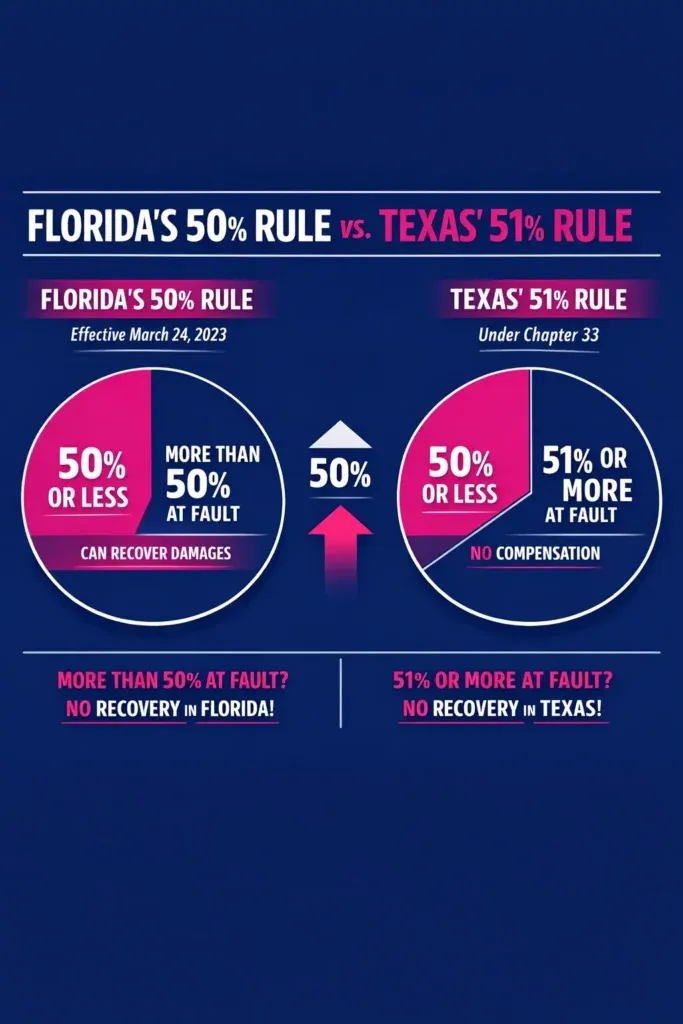
The rules involving comparative negligence are different in Florida and Texas.
Florida’s 50% Rule
As of March 24, 2023, Florida shifted from a pure comparative negligence system to a modified comparative negligence system under Florida Statute § 768.81. Under the updated law, an injured party can recover damages only if their share of fault is 50% or less. Anyone found more than 50% responsible is completely barred from recovering compensation. Prior to this change, Florida allowed recovery even if a plaintiff was 99% at fault, that is no longer the case for claims filed after March 24, 2023.
Texas’s 51% Rule
Texas follows a similar but slightly more plaintiff-friendly standard under Chapter 33 of the Texas Civil Practice and Remedies Code. In Texas, an injured party is barred from recovering only if their percentage of responsibility exceeds 51%. If you are found 51% or more at fault, you recover nothing. If you are 50% or less at fault, you recover damages reduced proportionally by your percentage of responsibility.
A Real-World Example of How This Works
Understanding comparative negligence is easier with a concrete example. Suppose a driver runs a yellow light and collides with another driver who was slightly exceeding the speed limit. A jury determines the first driver is 70% at fault for running the light and the second driver is 30% at fault for speeding. If the second driver suffered $100,000 in damages, their recovery is reduced by their 30% share of fault, leaving them with $70,000.
Now consider if the fault were reversed, the speeding driver is found 60% responsible and the other driver 40% responsible. In Florida, the 60% driver cannot recover anything. In Texas, the same result applies once fault exceeds 51%. These distinctions matter enormously, which is why how fault is argued and documented early in the claims process is so critical. Our resources provide further guidance on how personal injury claims work in both states.
How Insurance Companies Use Comparative Negligence Against You
Insurance adjusters understand comparative negligence very well, and they use it strategically. When a claim comes in, their goal is to assign as much fault as possible to the injured party in order to reduce the payout. Common tactics adjusters use to inflate your share of fault include:
- Pointing to minor traffic violations: Any infraction on your record or at the time of the crash can be used to argue you contributed to the collision
- Questioning your speed: Even slight speeding can shift a meaningful percentage of fault in the insurer’s favor
- Using your recorded statements: Offhand comments made early in the claims process can be taken out of context to suggest you bear more responsibility than you do
- Challenging your lane position: Where your vehicle was in the lane at the time of impact is frequently scrutinized as a contributing factor
The fault percentage assigned to you is not fixed, it is argued, negotiated, and in litigation, decided by a jury. Having legal representation that actively contests inflated fault assignments can significantly change the outcome of your case. Our case results demonstrate what skilled advocacy in shared-fault cases can achieve.
Contact Amanda Demanda Injury Lawyers in Miami and Houston
Shared fault cases are among the most complex personal injury claims, and the stakes are high. A difference of even a few percentage points in how fault is assigned can dramatically change what you recover. At Amanda Demanda Injury Lawyers, Attorney Amanda Demanda brings the same hands-on commitment to every case, working directly with clients to build the strongest possible argument for their compensation. She knows how insurers think and how to counter their tactics effectively.
Whether your accident happened in Miami or Houston, our firm is ready to stand behind you. We work on a contingency fee basis, meaning you pay nothing unless we win. Learn more about our firm on our about us page, and when you are ready to discuss your case, connect with our team through our contact page.
Back to Blog