




Most people hurt in an accident don’t expect to end up in a courtroom. They assume their case will be handled through negotiations, a settlement will be reached, and life will move forward. That’s true much of the time. But sometimes, going to trial isn’t just an option; it’s the right move. Understanding why some Florida personal injury cases make it to court can help you know what to expect if yours doesn’t settle quickly.
At Amanda Demanda Injury Lawyers, we’ve guided countless clients through both paths. Attorney Amanda Demanda is a nationally recognized personal injury attorney named to the Top 100 Lawyers by the National Trial Lawyers and recognized as a Super Lawyer. If you’re navigating the aftermath of an injury, reaching out to our team for support is a strong first step.
The Settlement Process and Why It Sometimes Falls Apart
Settlement is the most common outcome in personal injury cases. According to data from the U.S. Courts, only a very small percentage of civil cases actually go to trial, which reflects how often both parties find common ground before a jury gets involved. Settlements save time, reduce costs, and give victims faster access to compensation.
That said, negotiations don’t always work. When an insurance company refuses to offer fair compensation or disputes who was at fault, a settlement can fall apart entirely. At that point, the case moves toward litigation, and the question becomes whether a judge or jury will deliver the justice the insurance company wouldn’t.
Common Reasons a Case Goes to Trial
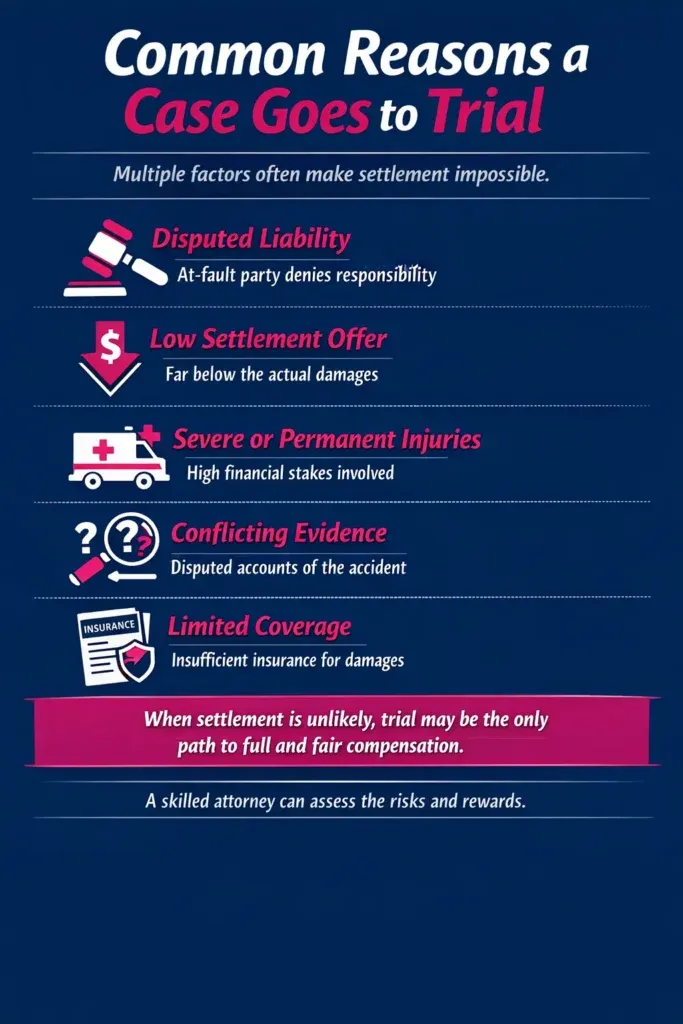
There isn’t one single reason a personal injury case ends up in front of a jury. More often, it’s a combination of factors that make settlement impossible or unwise.
Some of the most common reasons include:
- The at-fault party disputes liability and denies responsibility for the accident
- The insurance company’s settlement offer is far below the actual damages
- The injuries are severe or permanent, making the financial stakes high
- There are conflicting accounts of the accident and disputed evidence
- The defendant has limited insurance coverage relative to the damages
When any of these factors are present, pushing the case to trial may be the only way to pursue full and fair compensation. A skilled attorney can evaluate whether the risk is worth the potential reward.
The Role of Evidence and Case Strength
One major factor in deciding whether to go to trial is the strength of the evidence. Cases with clear liability, solid medical documentation, and credible witnesses are strong candidates for trial because they give the injured party a real chance of winning. When you have the evidence to back up your claim, a courtroom becomes less of a gamble and more of a forum for facts.
Cases with disputed facts or gaps in documentation are trickier. That doesn’t mean they can’t go to trial, but it does mean your attorney needs to be strategic. Reviewing the legal resources available to injury victims can help you understand what documentation matters most from the start.
What Happens When a Case Does Go to Trial
Going to trial is not a failure. In many cases, it’s a calculated decision made to protect your right to full compensation. During trial, both sides present evidence, question witnesses, and make arguments before a judge or jury. The process can take days or even weeks, depending on the case’s complexity.
Many injury victims worry that going to trial means waiting years for any money at all. While litigation does take longer than settlement, the outcome can be significantly better. Jury verdicts in strong cases can result in far higher awards than what an insurance company ever offered at the negotiating table. You can also review our case results to see examples of what we’ve achieved for real clients.
What to Expect During Litigation in Florida
Florida has specific rules governing how personal injury cases move through the court system. Under Florida’s statute of limitations, most personal injury and wrongful death cases must be filed within two years of the injury. Missing this deadline can bar you from recovering any compensation, so timing matters from the start.
Once a lawsuit is filed, both sides go through a phase called discovery, during which they exchange information, take depositions, and gather evidence. This phase often sparks renewed settlement discussions, and many cases are resolved during or after discovery.
Amanda Demanda Injury Lawyers Is Ready to Fight for You
Deciding whether to settle or go to trial is one of the most consequential choices in any personal injury case, and you shouldn’t make it alone. At Amanda Demanda Injury Lawyers, we analyze every angle of your case, from the evidence to the insurance company’s behavior, before recommending a path forward. Attorney Amanda Demanda has been recognized by the American Institute of Personal Injury Attorneys, the Florida Justice Association, and the National Academy of Personal Injury Attorneys, and she brings that level of commitment to every case we handle.
Whether your case resolves through negotiation or ends up in front of a jury, we’re prepared to fight for the compensation you deserve. We serve clients throughout Miami, Tampa, and Houston, and we work on a contingency basis, meaning you don’t pay unless we win. If you’re ready to talk about your options, contact us today to get started.
Back to Blog